Tuesday, April 22, 2014

Hidden Treasures! A peek into the museum archives.
By Fiona Shirkie, Collections Intern

If you are anything like me, and hopefully you are, you find a trip to a museum an adventure. As I move from gallery to gallery I am fascinated by the objects on display and the stories behind them. But the items that are on display are only half the story (or in some cases only 2% of the story!). All museums care for many more objects than those they are able to display. The Smithsonian Institution has an astonishing 137 million objects in its collection. It is only able to display 2% of these at any given time. The same is true here at the Gaston County Museum – although on a smaller scale.
One of my projects is to look through some of these ‘hidden’ objects stored in the archives. It is important to regularly check the condition of these items, document and research them further. Reviewing what is in the archives also helps to generate ideas for future exhibitions.


This project may seem like a daunting task – do you see the number of boxes!! However to someone like me this is a fabulous opportunity to delve into history. I have not been disappointed. I have been both excited and moved by some of the items that I have been fortunate enough to work with.


As they say the longest journey begins with a single step, so I selected my first box. Can you believe what I found – a picture of U.S. Representative for North Carolina (1957-68) Basil L. Whitener with not one, but two future Presidents! Seeing these three men gathered in 1960 I was reminded of the great hope that President Kennedy would inspire and also of his tragic death and its impact in the USA and around the world.
Having walked around Dallas Court Square many times, imagine my surprise as I discovered what appear to be the deeds relating to the Smyre-Pasour House, the oldest remaining residence in Dallas. The first of these documents was a deed from 1849 granting J.F. Smyre lot 8 on the Court Square for $187 and the second the deed passing this lot to Eli Pasour in 1851 for $650 – a nice profit! Eli would go on to purchase lots 7 and 9.

I was moved as I shared in the life of Yvonnie C. Hill documented in the diary that she kept daily from 1934-51. She shares everything from day to day things like how much the Doctor’s bill was or going on an Easter egg hunt to a very special moment shared with her beau and husband Johnnie in 1934 when Yvonnie “told him that I loved him”. I couldn’t help but feel for the young man from the mid-1800s writing to his mother and father from the ‘Wake Co Insayn Asylum’. I held in my hand the Book of Worship that Reverend M.L. Little, a Lutheran minister who served in Lincoln and Gaston County, had in his pocket when he was killed in a train crash in 1891. These objects reminded me that behind history and every object we see in a museum are very real people and unique stories. Preserving these objects to share with current and future generations is a central part of the museum’s mission.

Wednesday, April 16, 2014

Searching for Hoffman's at Spencer Mountain


By Jason Luker
Exploring history is an absolute joy. I assume you agree since you are reading a blog facilitated by a museum. What makes history so enjoyable to me is when I am able to make connections. When I am able to take one moment in time, connect it to another moment in time, and then see how those different points have influenced modern society. I have been experiencing this while researching the Hoffman family (those that built, owned, and operated the building the Gaston County Museum now resides in). One of the most treasured resources that I have at my disposal for research is the book Our Kin written by Laban Miles Hoffman published in 1915. Laban was a son of Jonas Hoffman, Jr. who operated the Hoffman Hotel from 1868 until his death in 1901. Our Kin is a very detailed genealogy for the early history of Gaston County and Laban also writes about visiting some of the original historical sites in the county as he performs his own research. I find great pleasure trying to follow Laban’s footsteps and see what remains.
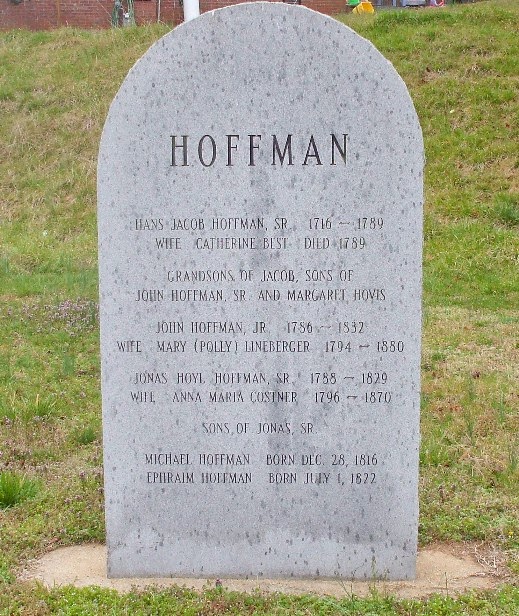
Grave Marker Located at Spencer Mountain
One of these explorations led me to Spencer Mountain, just a few miles from Dallas, NC. At the foot of this small mountain, right along the South Fork River had been a homestead of Jonas Hoffman, Sr., Laban’s grandfather. Jonas Sr. died in 1829 at the age of 41. His property apparently went under the control of his father John Hoffman who willed the land to Jonas, Sr. children after his own death in 1832.

Not much is known about Jonas, Sr. and what little I have been able to learn has come from Our Kin. Laban records that the land willed to his father and uncles was referred to as “Jonas Hoffman Mill” tract and was located where the Spencer Mountain Mill stood in the 1900s. When Laban visited the location, he described what remained of the family cemetery that contained the remains of his grandfather, grandmother and other unknown descendants. Even in the early 20th Century there was not much left of the gravesite. I and a couple of fellow Museum staff members went out to see the site for ourselves. The only grave marker left is a modern stone providing information about some of the Hoffman’s that were buried along the ridge line next to the South Fork River. They included not only Jonas, Sr. and his wife Anna Maria Costner Hoffman, but also Hans Jacob Hoffman, the first Hoffman that moved into this part of North Carolina back before the Revolutionary War. It appears that this land had been some of the original tracks owned by the family.
Jonathan Roach Spencer Mountain Mill Sketch
The historical connection that really washed over me was the fact that the site had been known as the Jonas Hoffman Mill prior to building of the Wilson & Moore Mill (what came to be called Spencer Mountain Mill) in 1874. One of the questions I have been trying to answer is why did Gaston County become so dominated by textile mills. By 1900, 24 large textile mills were already operating in Gaston County compared to only 16 in Mecklenburg County. One of my theories is that Gaston County had developed an infrastructure that catered to the textile mills. Due to earlier industry endeavors, textile mill owners were able use the developed land, harness the powerful waterways, and flourish in cotton textile production. At Spencer Mountain I can see this play out. When J. Harvey Wilson II and his brother-in-law J.W. Moore purchased the South Fork property for their mill, the area had already been developed by the Hoffman’s for their own use.


Remains of Spencer Mountain Mill


Not much is left out at the site. Spencer Mountain Mill is gone and only the foundation and dam remain. However, finding these connections helps me and hopefully others better understand how Gaston County was formed and what life might have been like for those first influential settlers like the Hoffman’s. If anything, the search excites me and makes me want to find out more. If you have any questions about the research we are doing at the Gaston County Museum, please let me know. Also, if you are doing your own research and have some information to share, I would love to hear from you. Just give me a call at 704-922-7681 ext. 105 or email me at Jason.luker@gastongov.com.

Monday, April 7, 2014

Adventure Is Out There!
By: Kelly Mason

Winter Holiday Program
It is that time again, to say goodbye to our Education Intern. Susan Voskuil came to us in the beginning of the fall and has been an important part of our education team. As we bid Susan goodbye, it brings back so many wonderful memories. We have had many interns come and go, all bringing their own unique personalities and talents. We are very fortunate here at the Gaston County Museum to have so many talented people share their time with us!

Over the past few months we have had a lot of transition here in the Education Department. Susan has been involved in everything from historical research, program development, and program implementation. Interns not only give new life through their new ideas and an outside perspective, but they also give the gift of friendship and memories that last a lifetime! Susan is a wonderful person and an incredibly gifted educator. We have had the privilege of teaching alongside Susan for the past 7 months. I have grown tremendously not only as an educator in the museum field, but also as a person because of her contribution in our department!

Education Department
The Sun Parlor
We want to thank Susan for her dedication, hard work, and beautiful spirit! We want to wish her all the best in the future! You will forever be in our hearts! Go and do great things at the Museum of the Grand Prairie! Adventure is out there my friend!


Monday, March 24, 2014

National Day of Happiness
by: Regan Brooks- Registrar

Yesterday was the first day of Spring, also known as The National Day of Happiness (Coincidence? I think not!) And even though the forecasters are saying Winter hasn’t quite left the stage yet, the gorgeous day today makes me hope they’re wrong. Something about the coming of spring just puts a smile on your face. Speaking of smiles, (were we? Roll with it, folks) Curatorial has recently been reviewing some of our glass plate negative collection in hopes of getting some grant money for conservation. These are all from local photographer, Harley Ferguson and show a glimpse of the folks living in the area at the turn of the last century. Not too many smiles, huh?


Of course, we can forgive the young soldier for not smiling.  Not too much of a reason to do so when you’re about to get shipped off to the killing fields of Europe. Honestly, he looks a bit worried. But, shouldn’t you at least smile on your wedding day?


“But Regan, life was hard back then. You should know that!” “People had it rough, they didn’t smile as much.” “Pictures were a big deal; it was a serious affair. You couldn’t just whip out your camera and take a picture!” Right? Wrong. Now, I grant you, these particular photos were from a professional photographer, so yes it was a bit more of a ‘serious’ affair (how many times did your mom have tell you to stop playing and smile nicely for that family portrait?) But Brownie disposable cameras were widely available at your local drugstore for $1 in 1900. Picture taking was becoming pretty commonplace.

“Okay, we get that. But still, life was hard back then.” And it’s easy now? Different times, different stresses. And different behavior expectations. People smiled just as much back then as they do now, just not in pictures. To be sure, photography was a lot more prevalent, but society still wasn’t far from the days of having to sit for hours while an artist painted your likeness, a process both time-consuming and incredibly expensive. For such a product, you did not want to come across looking like a fool, so you sat still and looked somber. And that translated over into photography. Society in general still had the idea that regardless of how happy-go-lucky you were, for a picture, you sit still and don’t act the fool.

Of course, some folks’ personalities were apparently so jovial, they didn’t care.


Do I detect a slight smile there, Dad? I'm thinking so!

Monday, March 17, 2014

How Museum’s Prepare for their Learners
by: Jeff Pruett- Director


A museum serves to educate its public in a variety of ways.  We are first and foremost a learning environment for our many patrons through our varied programming options and exhibits.  We also interpret, explain, and focus on meaning of various subjects.  Finally, we look at identity, motivation and interest of our learners.  These three themes each emphasize different aspects of the learning setting: the design of the environment, the interface between people and the environment, and people themselves.  These different themes when looked at together help us see that the whole is more than the sum of the study.  When staff creates this framework or foundation, it makes for a better learning experience for our visitors.

1. Learning and Learning Environments The first theme expresses the relationships between learning and the design of learning environments (such as galleries).  Museum staff addresses the many ways that images, text, models, etc. serve as mediators for learning, and they search how the findings from these studies inspire the progress and design of exhibits.  Learning and learning environments definitely go hand in hand.  Museum professionals look at theory and design experiments to determine the best experience for our visitors.     


2. Interpretation, Meaning and Explanation The second theme focuses on meaning, interpretation, and explanation as products and processes of social interaction.  Here, the interaction between curators, the institution, the designer, docents, is vital.  Again, text, images, etc. are focused on, but specifically how they affect the issues of meaning, explanations, and interpretation.  We address how patrons and varied groups make sense of their experiences in museums, focusing on the nature of intentions and social interactions among viewers, as well as between viewers and the museum. This theme guides our study of how meanings are influenced by interactions.

3. Identify, Motivation and Interests The final theme looks closely at the previous experience related to the individual’s identity as a learner.  This theme influences additional museum involvement and serves as a means in which a visit can continue to play out in a visitor’s future.  This theme also considers how museum experiences change the ways that people see themselves as learners of varied subject matter such as art or history.      

Monday, March 10, 2014

The Gaston County Museum would like to welcome our new Curatorial Intern, Fiona Shirkie!

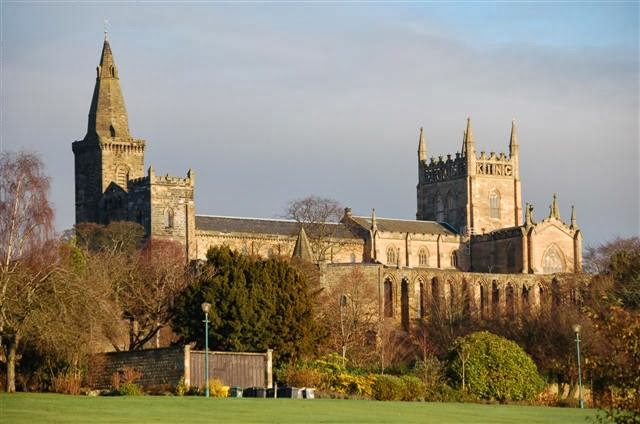
Dunfermline Abbey and Palace by Paul McIIroy

My name is Fiona Shirkie and I am the new curatorial intern at the Gaston County Museum. I thought I would take some time to introduce myself. After a successful 10 year career in Customer Service I decided to return to my first love – history. I went back to school and have recently graduated with a Masters in Museum and Gallery Studies from the University of St Andrews, Scotland. I have been fortunate enough to work with the British Golf Museum, The BlackWatch Museum and Stirling Castle in the UK.

I am Scottish and come from a town called Dunfermline. Dunfermline was the ancient capital of Scotland and many Scottish Royals, including Robert the Bruce, are buried in the town. It is 3,784 miles from Dallas. To say that the weather is different would be an understatement. The usual forecast is sunshine and showers, even in the summer! The coast is only 3 miles away. At first glance the two towns appear to have little in common – but the tie that binds us is Textiles.

Textiles were big business in Scotland for hundreds of years. By 1838 more than 100,000 people were employed in the industry.[i] Dunfermline was famously the home of silk and linen, particularly damask linen after an early case of industrial espionage (James Blake stole the method of damask production from a Huguenot factory). The area had 34 mills and the larger ones had depots across Europe and the Commonwealth. The impact that these mills had on the area and its people was huge.

Issues such as child labor and workers disputes arose. Post WW1 competition from other countries, supply and tariff issues led to a decline in the industry. Sadly the last remaining mill closed in 1989.

The team here at the museum has been very welcoming. I am looking forward to learning more about the similarities and differences between our two countries and towns and to working with and learning about some of the fabulous objects in the museum’s collection. I hope that you are able to come along to the museum to see some of these objects for yourself. Each of them has its own unique story.


[i] http://www.origins.net/help/resarticle-so-weaving.aspx

Monday, March 3, 2014

To Streak or Not to Streak
by: Stephanie Elliott- Curator


I get asked a lot about how we come up with the exhibits we do here at the museum. First you have to start with a topic. Easy enough, right? Well, then you have to decide how you are going to make that topic exciting and engaging for everyone from the 6 year old that is at the museum with his family to the person that was dragged along for the ride and doesn’t really want to be there.  It is our job as museum professionals to educate the public, but also to entertain them.  

So what kind of museum visitor are you?

Do you move quickly through exhibitions, scanning for points of particular interest, but rarely lingering for long? Then you are a streaker.  

Do you move more slowly, paying more attention or less at various places? Then you are a stroller.


Are you conscientious and diligent, moving very slowly through a gallery, trying everything and reading all of the text? Then you are a studier.


Now, I will admit that I have been one or all of these types of visitors in the past. “But you are a museum curator,” you say. I know, I know.  But sometimes an exhibit topic is just not that interesting to me or I’m just not in the mood to read every word on a text panel.  It’s okay to be a streaker sometimes.

So the trick to creating a great exhibit is to have something for everyone.  For example, in planning our current exhibit The Evolution of Recorded Sound, we wanted to include smaller interesting facts that a “streaker” could take away and have a broad sense of what the exhibit was about, but also include the nitty-gritty history for the avid phonograph or record player buff.  We also included several hands-on stations for kids to help occupy them while their parents are reading about the 1900s phonograph or reminiscing about their youth listening to a record player.  

Obviously there is a lot more that goes into the exhibit planning process – a lot of brainstorming sessions, research, budgets, fundraising, and designing – but it is always an exciting process and we hope that each exhibit we do appeals to our broad audience of interested (and sometimes not so interested) visitors. Plus, we are always looking for new ideas for exhibits, so if you have any please share with us in the comment section!